THE AIMING POSTThe Royal Australian Artillery Historical Society
of Western Australia NewsletterIssue 2/2003 June — August 2003
Presidents’ MessageThe War in Iraq clearly demonstrated the re writing of the manner in which Wars will be conducted and also the impact small dedicated terrorists can produce on the international scene.
These have brought to the notice of many that times have changed and the future holds many uncertainties and challenges.
We hope that actions will be implemented on the National Level to create the resources necessary to meet these changing times which appear will continue for many years.
The Society has arranged for a Breakfast Get Together for members and their friends on Sunday 17 August and will be held in the Athol Hobbs Room at the Royal Freshwater Bay Yacht Club, Peppermint Grove.
All are welcome.
Bruce G. Campbell
President
Tractors, Artillery (Aust) No.6By Bob Glyde
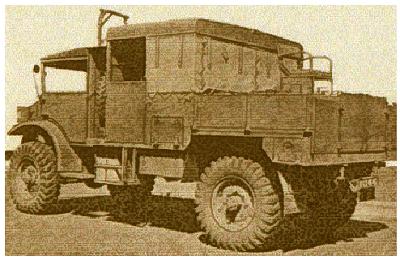
In a previous “Aimimg Post we presented Tractors, Artillery No.s 3, 3A, 8 and 9. The latter two were Australian designed bodies on the Canadian 4x4 Ford and Chevolet chassis. There was another based on the same chassis, this being the Tractors,Artillery (Aust) No. 6.
The body was purpose built to meet the requirements of the Light AA gun (40 mm) or in other words the 40 mm Bofors LAA gun.
The body had a composite cabin and back type of steel with canvas curtains and seated a detachment of seven, including the driver. Ammunition lockers were provided on each side of the body and a space was provided in the centre for a spare gun barrel. Ditching gear was provided, as was storage for fuel and water in 2gallon cans, and rations. There was space for the stowage of blankets and personal gear in the form of lockers positioned around the body.
An observation hatch was fitted in the lefthand of the cab roof which gave access to the Universal AA LMG Mounting. There was a further hatch in the roof of the cabin behind the cab.
A 7000 lb (3175 kg) WD Winch, driven from a power takeoff, was mounted on the chassis beneath the body. Guide rollers and shreaves were arranged at each end of the vehicle so the winch could haul from either front and rear
An unusual feature of the equipment was that one member of the detachment occupied a seat situated on the lockers at the rear. It was open to the elements. One might think this detachment member was intended to be a spotter of hostile aircraft but his task was far more subtle according to the Master General Ordnance equipment document from which the information on the equipment was gleaned. He was there primarily to control the hydraulic brakes on the gun by means of a rope, which activated the mechanism.
It would be interesting to hear from any personnel whose unit was equipped with these vehicles during 1942/45. Was the seat used as originally designed? The writer, who observed a number of these vehicles operating in convoys moving into the Geraldton area during the 1942/43 period, cannot recall seeing the seat being utilised in the manner described above. It would have been a very unpleasant place to travel as the dust from the unsealed roads would have swirled around the unfortunate member. There may be other comments about the vehicle which would be of interest to other members of the Society. Please let the Editor have your comments! We would also be interested in photographs if any are available. They can be copied and returned if you so wish
Information Source:
Master General Ordnance Equipment Memorandems. Date and other identification unknown.
A Relic of the Gallipoli Evacuation
By Bob Glyde
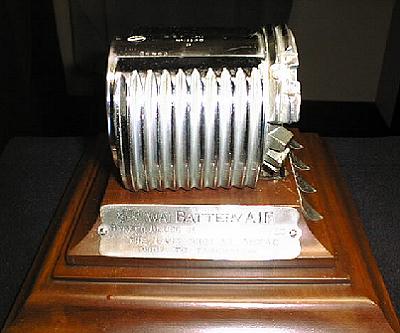
The 7th Field Battery Unit Collection at Irwin Barracks, Karrakatta in Western Australia, includes an important item of Australian Field Artillery heritage. It is the breech block of the last 18 pr field gun in action at the Anzac position at Gallipoli on 19th December 1915.
At that time, as part of an elaborate deception plan, a sub section of 8th Field Battery, 3rd Field Brigade AFA, was kept in action until the last hours of the evacuation.
In 1978, Fred Cunningham, who was a member of the gun detachment, became technically blind and rather courageously decided to learn touch typing so he could keep communicating with his many friends. His tutor was a woman, herself totally blind, working from the Braille Society in Perth. As a result he set down his recollections of the evacuation, an action he admits he should have taken sixty years earlier.
The decision to evacuate the troops from Anzac Cove was made in October 1915 with the initial prediction of 50% casualties by General Hamilton who was sacked four days later presumably because of his negative thinking. The planning continued in great secrecy by his replacement, General Monroe, who was faced with the task of evacuating as many of the 45 000 troops as possible from the peninsular.
There always seems to be one of them, a soldier with all the very latest “good oil” from reliable sources. Such a person existed in Fred’s subsection, he was not a member of the gun detachment, perhaps a driver or some one, who after completing his duties for the day, was able to sneak off to Anzac Cove which was the centre of activity. He returned with the possible evacuation story quite early in the piece which the troops treated with disdain and ridicule. Gradually however, as the winter approached, there was concern that the facilities at the Cove would not stand up to the storms and the troops could foresee a shortage of supplies and ammunition.
Eventually the other three guns of 8th Battery were withdrawn but even then the troops speculated that they were being taken out to cover another action further along the coast. This left the right flank of the line covered by the one 18 pr and an ancient 4 inch (102 mm) gun, which shared its projectiles amongst friend and foe alike.
The 8th Battery gun occupied a position about 15 feet (5 metres) below the crest on the reverse side of a ridge, named the Razor Back, on the right flank of the Australian front line. This gave the gun and its detachment some protection against direct fire of the Turkish artillery. From this site the gun was able to engage an olive grove which harboured “Beachy Bill”, a Turkish gun which harassed the Anzac positions almost from the first day of the landing. It was a gun with a low velocity and the troops soon learned the sound of its approaching shells and took action against the burst of shrapnel from them. This gun was responsible for many casualties at the beach at Anzac Cove.
In an attempt to eliminate “Beachy Bill” during the evacuation phase, the navy carried out a bombardment of the gun’s operational area, utilising a cruiser and two destroyers. During the bombardment, troops from both sides came up out of their trenches watching the spectacle. The bombardment went on for some time leaving the Olive Grove obscured in a cloud of dust and smoke. The ships ceased firing and before the dust had cleared, there was a distinct sound of “Beachy Bill” getting away the next round. This led to a tumultous cheer from the spectators whereupon they descended back into their respective trenches.
As time grew closer to the 19th December, those personnel in the sub-section not forming part of the gun detachment, were directed to search all the abandoned dugouts in the area to remove or destroy any equipment left behind by those troops who had already been evacuated. One party came across a demijohn of overproof rum and believing it would be sinful to pour it into the ground, disposed off it in the manner originally attended. This left them rather “non compas” for a few hours.
The day of the 19th dawned and as there was a good supply of ammunition for the 18 pr, it engaged in a “tit for tat” exchange of fire all morning with “Beachy Bill”. Cunningham was apparently slow in retreating to his foxhole after setting up his gun to fire the next round in one of the exchanges and “Beachy Bill’s” next shot burst at the rear of the gun pit. Cunningham was only partly in his foxhole and was hit by shrapnel on that part of him still exposed. It was the fifth time he had been hit by shrapnel since he had arrived at Gallipoli and fortunately no wounds were caused. This was the second time the Turks had put a shell into the gunpit and Cunningham put it down to the fact that the gun, like the 18 pr, was badly worn and had lost its accuracy. In the afternoon “Beachy Bill” was not in action so the Battery Commander switched to another target away to the left. After a few rounds at this target the order was given to increase the angle of sight by one minute. At the time Cunningham thought, bearing in mind the wear of the gun, the this order was ridiculous but made the correction ordered and fired. Immediately on firing he realised he had decreased the angle of sight by one minute which compounded to error to two minutes.
Immediately the Battery Commander was on the telephone congratulating the gun for having put a round into the gunpit of the enemy piece and that gun was lifted completely out of its pit. Later the Battery Commander came around to personally congratulate them however they did not dare to tell him of the error which had occurred.
“Beachy Bill” had not been in action since the morning skirmish and there being a few rounds of ammunition left these were sent off in his general direction later in the day.
The sub section was warned to be ready to move off to the beach at 2100 hours, in the meantime they were given instruction as to what action to take to prepare for the move. The gun was stripped of its dial sight and breech block and various members were responsible for the removal and disposal of these. The firing pin was removed from the breech by the Gun No.2, Cpl H Butler. The last cartridge case of the round fired was collected by the Battery Commander, Captain Waite.
The procedure for the evacuation called for each man to be issued with a rifle and bayonet with the magazine filled and fifty rounds in his bandolier. Blankets had to be cut into strips and made into mocasions to place over the boots to help deaden any noise. Strips were also wrapped around the bayonets so there was no reflection from them in the bright moonlight.. The unit artificer and an assistant had to remain at the gunsite and at 2200 hours were to destroy the gun with an explosive charge.
Although the gunsite was only about a mile from the beach and the personnel left at 2100 hours, they did not reach it until 0100 hours 20th December. The organisation must have been excellent as there were 5 000 personnel still ashore at daybreak on the 19th. Cunningham commented that large barges were working a shuttle service from the jetties at Anzac Cove to the transports standing close off shore. The detachment were amongst the last to be lifted off before the rearguard came down from their defensive positions.
There is still speculation today as whether the Turks were aware that the evacuation was taking place and rather than mounting an attack, were pleased to see the Anzac positions evacuated. Other researchers believed that had the German General von Sanders commanding the Turkish Army at Gallipoli been aware of the activity, he would have ordered an attack to create as many casualties as possible amongst the retreating troops.As it was, the British had established an advanced dressing station at the beachhead manned by volunteer doctors and medical staff.
Had the rearguard had to fight their way back to the beach, all the wounded would have been brought to this point and those who could not be moved, were to be left to mercy and compassion of the Turkish troops who captured them. Fortunately the fecility was not required.
Some thirty years later an article was printed in the Bulletin magazine which stated “ A correspondent writes that whilst travelling in South Australia, he came across an interesting souvenier of the 1914-18 War. It was a dinner gong in the home of Lt Col W C N Waite and was the inscribed case of the last shell fired from a field gun on the 19th December 1915, 8th Battery, 3rd F A Brigade, Captain WCN Waite Commanding, Sgt SG Brearley, Cpl H Butler, Gnr F Cunningham.”.
One must speculate whether this dinner gong still exists either amongst Lt Col Waites descendants or perhaps in an artillery unit mess in South Australia?
Information Sources: An 18 page unpublished manuscript “Achieving the Impossible” written by Fred Cunningham, March 1978. A copy held in the RAA Historical Society library, Hobbs Artillery Park, Karrakatta.HANDOVER CEREMONY:
On Saturday, 29th March, representatives from our Workshop Team attended a rededication ceremony conducted by the City of South Perth Returned & Services League, marking the return of the fully restored 25pr Memorial Gun Howitzer to their Sub-Branch on the corner of Angelo and Anstey Streets South Perth. The restoration was by far the best result the Team has achieved and drew praise from all who attended the ceremony. The brief ceremony was attended by the Mayor of South Perth who conducted the Official Rededication in the presence of the State President R&SL, State and Federal Members of Parliament, Members of Kindred Organisations and Councillors.
Don Rae
Anzac Day 2003
By Tom ArnautovicMany members of the Gunner fraternity with spouses, sons and daughters and some with grandchildren together with Officers, SNCO’s and soldiers of 7 Field Battery participated in a Gunners Dawn Service at Hobbs Artillery Park on Anzac Day 2003.
This is the 2nd year in succession that the Battery has hosted a Gunner Dawn Service. Last year’s inaugural Gunner Dawn Service attracted in the order of 110 to the Service and this year in the order of 140 attended. The service included the Brigade Padre leading pray’s and speakers including the Colonel Commandant Brigadier Richard Lawler, and speakers from the Battery to commemorate our fallen Gunners.
The setting for the Gunner Dawn Service is in front of Hobbs Artillery park Building around the flag station which was lit up and looked spectacular in the early morn and sun rising directly behind the flag station. The Battery provided a Catafalque Party who were very professional and smartly turned out in their role and provided a ceremonial formality to the proceedings.
The Colonel Commandant together with Ray Bird, President of the Royal Australian Artillery Association WA, Peter Rowles President 3 Field Regiment RAA Association and the Battery Commander Maj Scott Sullivan laid wreaths.
For a donation of a gold coin a hearty breakfast was provided with coffee and rum for those needing an early morning starter. The drill hall was magnificently presented with sandbagged areas including a game area and stools and tables for the festive afternoon. Post March saw some 350-400 serving and past members of the Corps, family, friends and visitors partake in an afternoon of great camaraderie.
Next year will see the Dawn Service with a new limestone Memorial around the flag station. Members are urged to join fellow Gunners serving and non serving together with family members and friends at next years Anzac Day Dawn Service
VISITORS
By Don RaeDuring the past two months we have had the pleasure of hosting visits by the following distinguished persons:
Major General John Whitelaw visited Hobbs Artillery Park and the Leighton Battery Heritage Site on 10th April and was escorted by Members Bob Glyde and Don Rae. It was a great pleasure to welcome General Whitelaw and to be brought up to date on Gunner matters from the National point of view. Refurbishment of the Battery Official Collection was nearly completed and drew favourable comments from the General as was the case at Leighton Battery where many changes had been introduced since his last visit to Perth.
On 30th April we were pleased to welcome Brian Manns, Deputy Head Army History Unit Canberra, who spent several valuable hours providing our Wednesday Group of Volunteers the opportunity to discuss the latest developments affecting Army Museums and Official Collections throughout Australia.
Later, on 28th May, Warrant Officers Neil Dailey and Robert Jeffery spent the morning at Karrakatta in discussion with Captain Mike Hartas and Warrant Officer Matthew Sullivan from 7 Field Battery and our Wednesday Volunteers. Neil is the Army History Unit Technical Officer, a task that he combines with his appointment of Curator at the Bandiana Museum. Most importantly, he is an Artillery Warrant Officer! Robert Jeffery is the recently appointed Curator of the Infantry Museum at Singleton and, naturally, he is an Infantry Warrant Officer! Neil and Robert were attending the Museums Australia National Conference convened in Perth.
Two visitors to Leighton Battery on 29th May were also in Perth for the Museum Conference. Malcolm Traill from City of Albany is the Curator of Princess Royal Fortress and Adam Wolfe of the Western Australian Museum is the Regional Manager of the Geraldton Museum. Both visitors were keenly interested in our endeavours, Malcolm in particular due to the common link between Fremantle and Albany through Coastal Defence. Extending our network among organisations with Objects similar to our own can be most beneficial to all involved.
AN AUDIO EXPERIENCE
By Don RaePlanning is well advanced for the installation of a motion activated audio system in selected locations within the Tunnels Complex at Leighton Battery Heritage Site. This state of the art digital system will provide realistic “theme” presentations to enhance the authenticity of our guided tour dialogue and add to the popularity of the established tour destination. As the project develops we will keep you informed, ultimately inviting you to visit the sight to share what is confidently expected to be an exciting experience.
Norfolk Island – The Military Presence – 1939/45
By Bob GlydeThose of us fortunate enough to have travelled to Norfolk Island really cannot appreciate the turmoil and activity which must have been present during the wartime period of 1942/45. Who would have thought that the island, a pinpoint of land some 1600 kms east of Sydney and 770 km north west of Auckland, NZ, could have justified the military activity which occurred during that time.
The island had experienced a varied history since being discovered by Captain Cook in 1774. A penal settlement was established in 1788 and lasted until 1815. At the time the settlement was abandoned all the buildings were raised to the ground in case a foreign power decided to lay claim to the island. In 1825 the second penal settlement was founded and lasted until 1856.
In the same year Queen Victoria granted the island to the descendents of the HMS “Bounty” mutineers who were finding that Pitcairn Island was becoming overcrowded. The island was placed under Australian authority in 1914 and remained so until the Norfolk Island Legislative Assembly was elected in 1979. Although there are close links with Australia and New Zealand, the islanders are fiercely independent. Their principal industry is tourism and they do rather well at it.
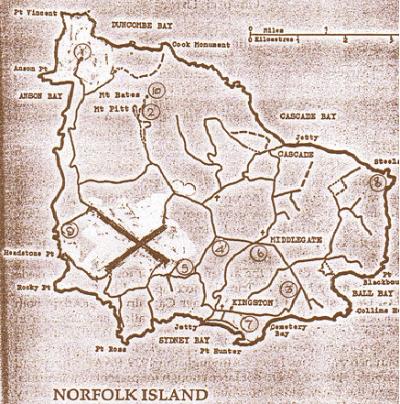
The island was a junction for the trans Pacific cable which ran from Australia and New Zealand through to Hawaii thence to Canada. This then gave access to the trans Atlantic cable to the United Kingdom. Security had to be provided to ensure there was no interference with the cable station. Norfolk Islanders had formed a Norfolk Island Infantry Detachment in 1939 to undertake guard duty at the cable station and possible landing beaches, principally at Kingston and Cascade Bay. Their heaviest weapons comprised Vickers machine guns. This appeared to have been supplemented in July 1942 by an Australian unit of 80 men mainly Norfolk Islanders.
Prior to World War 2 consideration had been given by the RAAF to build an airstrip. Some preliminary studies were done. The island was ideally situated as a “mid ocean aircraft carrier” and this became all the more important with entry of Japan into the war.
The first work on an airfield started in September 1942 when a party from the NSW Main Roads Dept landed on the island. They had come from a similar task at New Caledonia. All equipment had to be landed by barges from a vessels lying off either Cascade Bay or Kingston, depending on the weather. The barges had to offload their cargo onto the small piers which dated back to convict times. People who have been to the island will understand the enormous effort involved in landing material, heavy vehicles, fuel, 1500 tons of airfield steel matting, etc, etc.
At the same time the South Pacific Command requested the New Zealand government to provide a garrison, which eventually totalled 66 officers and 1416 other ranks. The garrison comprised the 36th Infantry Bn, 215th Composite AA Bty RNZA, 152nd Heavy Bty RNZA, a Troop of field guns and associated attached personnel. An advance party arrived late in September with the main body arriving in October. The Norfolk Island Infantry Detachment left the island in December leaving the defence of the island to the New Zealanders.
The NZ 36th Bn deployed companies to Cascades, Kingston and Anson Bay {the only landing point Captain Cook was prepared to come ashore in 1774), the reserve company deployed in the centre of the island.
The 152nd Heavy Bty was equipped with the 155 mm M1917A1 guns supplied by the US Army. Two of them covered the Kingston anchorage whilst the other two were emplaced on Mt Pitt, the highest peak on the island. Later the guns at Kingston were also moved to this area. The 3.7 in guns were placed to cover the airfield, but when ships were at the island discharging cargo the guns were sent down to cover the anchorage concerned. One of the LAA troops (4-40 mm Bofors) was at Anson Bay to provide protection for the cable station whilst the second troop was at Kingston protecting a radar unit. The troop of 25 prs were stationed near Kingston but being mobile were probably tasked to move to various danger points as required.
The airfield was operational by Christmas Day 1942 when a RNZAF Hudson bomber landed.. The first official landings occurred on 29th December when 2 Hudsons arrived. Sightings of enemy forces were noted towards the end of 1942 involving a Japanese destroyer and two submarines. However there were no actual attacks during the period of the war.
The building of the airfield involved the bulldozing of a treasured century old avenue of Norfolk pines. They still talk about it. The airfield was put to good use with a continual movement of aircraft landing and over flying the island. Hudson aircraft of the RNZAF were regular visitors as were C-47s of the USAF. Kittyhawks of the RNZAF used the airfield as a stop off and refuelling point on their way north to the battle zone around Papua New Guinea. On many days up to eleven landed to be refuelled, bring in mail, urgent supplies and equipment, etc. Airfield records for the February 1944 period recorded the arrival and departure of 214 aircraft. It perhaps can be said that at least the destruction of the avenue of trees was justified. The airfield could handle quite large aircraft with Liberator bombers, Avro York and other planes landing safely. The radar unit was able to assist aircraft flying the featureless sea between New Zealand and Australia on their way northward and on several occasions were able to save aircraft which had lost their bearings.
As the Japanese were forced on the defensive, the NZ Army contingent were withdrawn, Air force personnel taking over those duties which were still considered essential. In Dececember 1948 the control of the airfield past over from the RNZAF to the Australian Department of Cival Aviation.
This article prepared for “Aiming Post” by Bob Glyde.
Information Sources :“Defending New Zealand”. “The Pacific War, 1941- 1945 and Norfolk Island”. Author Gil Hitch.
1. 4 - 40 mm Bofor LAA guns. Cable Stn.
2. 2 - 155 mm guns. Mt Pitt
3. 2 - 155 mm guns. Kingston
4. Army HQ
5. 4 - 3.7 in HAA guns.
6. 4 - 25 pr guns, mobile role.
7. 4 - 40 mm Bofor LAA guns. Kingston.
8. HF/DF installation. Steele Point
9. 2 - 3.7 in HAA guns moved from 5 in 1943.
10. EW Radar installation. Mt Bates
APOLOGIES The Editor would like to apologise to all members of the Society for the lateness of this newsletter. My current study commitments and the birth of our fourth child last week meant that things were a little hectic, but in true arty spirit I amended the Fireplan and added a couple of weeks to all timings. (This will allow the enemy to catch up as well).
Enjoy the reading. GABBY.
The Harry Peck Trophy Browsing through the RAA—Customs and Traditions, compiled and edited by WO1 Christopher Jobson, and first published in 1997, I came across the history behind this particular trophy which was commissioned by Harry Peck and Co.( the makers of Peck’s Paste) in 1950. It is a 25 pounder gun carved out of wood, to scale, by Warrant Officer Adlam of the Australian Instructional Corps, and sprayed with bronze. The inscription reads:
By Gabby D’UvaPart 1
The Harry Peck Trophy for inter battery shooting and gun drill competition. Presented to the 5TH Field Regiment, AMF, by Harry Peck and Co (Aus) Limited, in recognition of the fictitious Gunner Harry Peck who served with such distinction in the 2/5TH Field Regiment, AIF.The Origins of the Mythical Gunner Harry Peck
The ‘official’ version of how Harry Peck was ‘born’ started in 1940 at Ingleburn Army Camp, NSW, when an officious orderly sergeant was inspecting the huts of the Gunners from the 2/5th Australian Field regiment, RAA. The sergeant, seeing an untidy bed strewn with gear and accoutrements, asked a Gunner standing nearby ‘Who sleeps in that bed?’ The answer came back in a flash, ‘That’s Harry Peck’s bed’. The sergeant noted the name of Gunner Peck in his book with a view to extra fatigues and left the hut.
The Gunner who had answered the sergeant was immediately turned to and asked ‘The bloke who sleeps in that bed isn’t named Peck— why did you say it was?’ Back came the reply ‘You don’t think I was dob in a mate, do you? That’s why I said Harry Peck slept there. You know Harry Peck…. The Anchovy King!’ This simple incident saw Harry Peck born and enlisted on the strength of the Regiment of the Royal Australian Artillery.
An alternative version to the story of the creation of gunner Peck proffered by some members of the 2/5th Field Regiment is that an officious orderly sergeant marched into the huts and demanded ‘Where is the duty driver?’ When it did not receive an answer, the sergeant demanded to know the name of the duty driver. It was Gunner Terry McGurren who answered ‘Harry Peck’. The orderly sergeant attempted to have Harry Peck put under arrest and charged for “Being absent from place or state of parade’……….To be continued……..
In next issue: “Harry Peck begins his Army career in earnest”
Adapted from; Royal Regiment of Australian Artillery - Customs and Traditions, compiled and edited by WO1 Christopher Jobson, 1997.
The Aiming Post is published by the Royal Australian Artillery Historical Society of WA (Inc) as a service to its members. It has an additional role of making information and material relating to Australia’s artillery and defence heritage available to individuals and groups who share the Society’s objectives.The Editor gratefully acknowledges the contributions to the newsletter by the members, whose names appear with the corresponding articles.
Articles, editorial comment or book reviews for publication should be submitted to the editor, Gabriel D’Uva at: Royal Australian Artillery Historical Society of WA, PO Box 881, Claremont WA 6910. Phone: 93836544 Fax: 93836370 or E-mail the Editor at info@artillerywa.org.au